Pastoral Friend Program
Overview and introduction
Listening and thinking are essential features of this Program. Pastoral care involves both of these elements. It is vital that we listen to those around us and especially to those for whom we are caring. Please think about what is presented in the modules and the accompanying videos and determine your own position on each of the issues discussed.
Our spirituality — the transcendent or uplifted nature of our "inner-self" — is central to our well-being. Everyone has spirituality; everyone has an "inner-self" that can be lifted above the ordinary. It's acknowledged that spirituality can attain even greater importance as people approach older age and the end of life, where a peaceful mind is sought. As one spiritual carer put it, "Our spirituality is what makes us tick!"
This PFP is designed to provide information about spirituality in a person's well-being — all ages are included — and about how pastoral friends can develop skills to encourage spiritual growth and help people achieve greater peace of mind. It provides:
- a context for a contemporary approach to pastoral conversations;
- a reference source for all pastoral carers;
- simple training for all people that includes a basis for further developing skills in pastoral care.
The PFP is based unequivocally on Christian principles. It emphatically endorses the Christian ethos as fundamental to all its activities, and liberally cites relevant Biblical statements.
A pastoral carer or a pastoral friend?
In a formal sense, a pastoral carer has more comprehensive training than a pastoral friend. Think of it as a continuum: at one end, a pastoral counsellor — trained in psychology and active counselling and listening. In the middle, a pastoral carer — trained and experienced in the theory and practice of pastoral care. And at the other end, a pastoral friend — someone who simply wants to be an effective friend, having developed basic aspects of listening and responding in pastoral and spiritual situations. It's this last category that's central to the PFP.
Spiritual Reflection
The Program is underpinned by an ethos of Spiritual Reflection. It's important that spiritual carers reflect on their own spirituality and the spirituality of others, placing spirituality — especially others' — in a wider context. It's also important to recognise the distinction between spirituality (an individual's inner-self) and religion (spirituality associated with a specific organisation or church). This Program is primarily concerned with the development of individuals.
Reflective practice
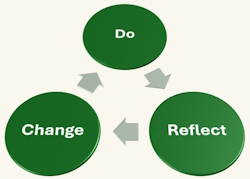
The main pedagogical foundation of the PFP relates to Reflective Practice. This involves spiritual carers reflecting on their own spirituality in a personal, emotional way; reflecting on spirituality in a broader Biblical context; and also in a broader secular context. These three types of reflection help carers understand themselves better in a living context — and they need to understand themselves before they can assist others more effectively. So, we DO, we REFLECT and CHANGE our next action if necessary, as shown in the following diagram.
At the same time, one purpose of pastoral friends is to help other people, of all ages, reflect on their own spirituality. Spirituality is deeply personal. For people to achieve greater peace of mind, spiritual carers need to develop skills that lead people into personal reflection, for themselves and in their broader context. Every opportunity should be taken by participants in this Program to engage in this reflection.
Infinite Respect
The Program is also founded on the principle of Infinite Respect, where carers respect all people in every aspect of their life, including their spiritual ethos — Christian, other faith traditions, agnostics, atheists and others. Infinite Respect doesn't mean friends endorse the beliefs or lifestyle of those they care for, but it does acknowledge every person's right to hold such beliefs. Confidentiality of carer and resident discussions and relationships is also fundamental, throughout this Handbook and the PFP.